The method
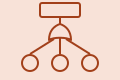
Fault tree analysis (FTA) starts from an undesired top event. It breaks it down, through AND and OR logic gates, into basic events: component failures, human errors, external conditions.
Its analysis yields minimal cut sets — the smallest combinations of basic events that cause the top event — and, when probabilities are available, the top event probability and the importance of each component. The method is described in IEC 61025.
Event tree analysis (ETA) goes the other way: from an initiating event, each barrier succeeds or fails, producing sequences with different consequences, each with its own frequency (IEC 62502). The two trees combine on either side of a bow-tie.
When to use it
- To quantify the probability of an undesired event and identify critical failure combinations.
- Redundant or multi-barrier systems: nuclear safety, aviation, safety instrumented systems.
- ETA: to assess the possible outcomes of an initiating event depending on barrier success or failure.
Watch out for
- Common cause failures (same manufacturer, same environment) can defeat redundancy: model them explicitly.
- A fault tree assumes binary states (working or failed); dynamic behaviour needs other models.
- Results depend on the reliability data used: state their source.
Steps (fault tree)
- Define the top event and the system boundaries precisely.
- Break the top event down into immediate causes, linked by AND or OR gates.
- Continue down to basic events for which data are available.
- Compute minimal cut sets, then the top event probability.
- Identify the most contributing components and single points of failure to address.
Fault tree and event tree software
List from the Aurorisk catalogue, links checked on 2026-09-26. Confirmed free access is listed first; unknown information is labelled.
| Tool | Source · licence · access | Scope | Description |
|---|---|---|---|
| Arbre-Analyst ↗ | Open sourceFree | France | Free fault tree tool based on the XFTA engine (Open-PSA); successor to OpenFTA. |
| Aurorisk — fiabilité (RBD & fail-safe / fail-dangerous) | Free for teaching | France | Teaching tool with two views (switch): reliability blocks (RBD, series/parallel/k-out-of-n topology, Monte Carlo) and dynamic fail-safe/fail-dangerous simulation (named failure modes per component, dependency rules for common-cause failures, proof test, editable safety logic, PFDavg). Not validated, not for real studies. |
| OpenFTA ↗ | Open sourceFree | International | Long-standing fault and event tree tool; this repository preserves the software whose original site is no longer reachable. |
| SCRAM ↗ | Open sourceFree | International | Probabilistic risk analysis: fault and event trees, Monte Carlo, Open-PSA format. |
| BlockSim (Ansys / ReliaSoft) ↗ | Commercial publisher | International | Industry-reference reliability block diagram (RBD) tool. Handles complex dependencies, standby redundancy, reliability allocation and life-cycle cost. |
| GRIF — Package Booléen (Satodev) ↗ | Commercial publisher | France | French dependability suite (25 years of R&D, formerly TotalEnergies): fault and event trees, RBD, bow-tie, reliability network, SIL loop, Albizia BDD engine. |
| Isograph Reliability Workbench (RBD) ↗ | Commercial publisher | International | Widely used in aerospace and defence. Full RBD module, integrated with Petri nets and FMECA. |
| Item ToolKit (RBD) ↗ | Commercial publisher | International | Dedicated RBD and functional safety analysis modules, by Item Software. |
| RAM Commander ↗ | Commercial publisher | International | Integrated RAMS solution (reliability, availability, maintainability, safety), by ALD Service. |
Standards and references
- IEC 61025 — Analyse par arbre de panne
- IEC 62502 — Analyse par arbre d’événement
- Open-PSA Model Exchange Format