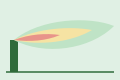
The method
The calculation starts from a source term: flow rate, duration, height and nature of the release (gas, aerosol, puddle vapour). It combines this source term with weather conditions — wind speed and direction, Pasquill atmospheric stability class, ground roughness — to estimate how the cloud dilutes as it moves away from the source.
The Gaussian plume model is the most common: it assumes a normal concentration distribution across and above the wind direction, with a spread (σy, σz) that grows with distance and depends on atmospheric stability. It suits continuous releases of gases lighter than or close to air density.
When the cloud is denser than air (cold gas, high molecular weight, aerosol), it behaves differently: it spreads near the ground instead of dispersing vertically. Heavy gas models (such as DEGADIS) handle this case, not covered by the Gaussian plume alone. The final result is a distance or footprint for each chosen toxicity threshold (AEGL, ERPG, national regulatory thresholds), drawn downwind from the source.
When to use it
- Safety report for a facility storing or using toxic or flammable substances (major-hazard, chemical sites).
- Emergency planning: estimating in advance the areas to evacuate or shelter for a release scenario.
- Training and awareness on the effects of an accidental release, to understand the influence of wind and stability.
Watch out for
- The stability class strongly changes the result: a stable atmosphere disperses little and gives longer distances than an unstable one.
- Applying a Gaussian plume model to a heavy gas underestimates the dangerous area near the ground.
- Toxicity thresholds used (AEGL, ERPG, national thresholds) must be cited with their source; they are not interchangeable without care.
- However careful, a dispersion model remains an approximation: a tool not validated against a reference code must not be used for a real decision.
Steps
- Characterise the release: substance, flow rate or total mass, duration, height, temperature.
- Choose the scenario’s weather conditions (wind speed and direction, stability class) — often several sets, from worst-case to most frequent.
- Decide whether the cloud should be treated as light gas (Gaussian plume) or heavy gas, based on its density relative to air.
- Compute concentration as a function of distance and compare it with the chosen toxicity thresholds.
- Draw the footprint for each threshold, and plot it on a map if needed.
Atmospheric dispersion software
List from the Aurorisk catalogue, links checked on 2026-09-26. Confirmed free access is listed first; unknown information is labelled.
| Tool | Source · licence · access | Scope | Description |
|---|---|---|---|
| Aurorisk — dispersion | Free for teaching | France | Teaching tool: Gaussian plume, release sources and toxic thresholds, with map. Compared with ALOHA on reference cases, but not validated for real studies. |
| RMP*Comp (EPA) ↗ | Public bodyFree | United States | Threshold distances for US risk management plans. |
| EFFECTS (Gexcon) ↗ | Commercial publisher | Europe | Effects models based on the TNO Yellow Book. |
| FLACS (Gexcon) ↗ | Commercial publisher | Europe | CFD dispersion and explosion simulation. |
| Phast (DNV) ↗ | Commercial publisher | International | Consequence analysis (release, dispersion, fires, explosions). |
Standards and references
- CCPS — Guidelines for Chemical Process Quantitative Risk Analysis
- TNO — Yellow Book (CPR 14E)
- Arrêté du 29 septembre 2005 (France) — probabilité, gravité, cinétique